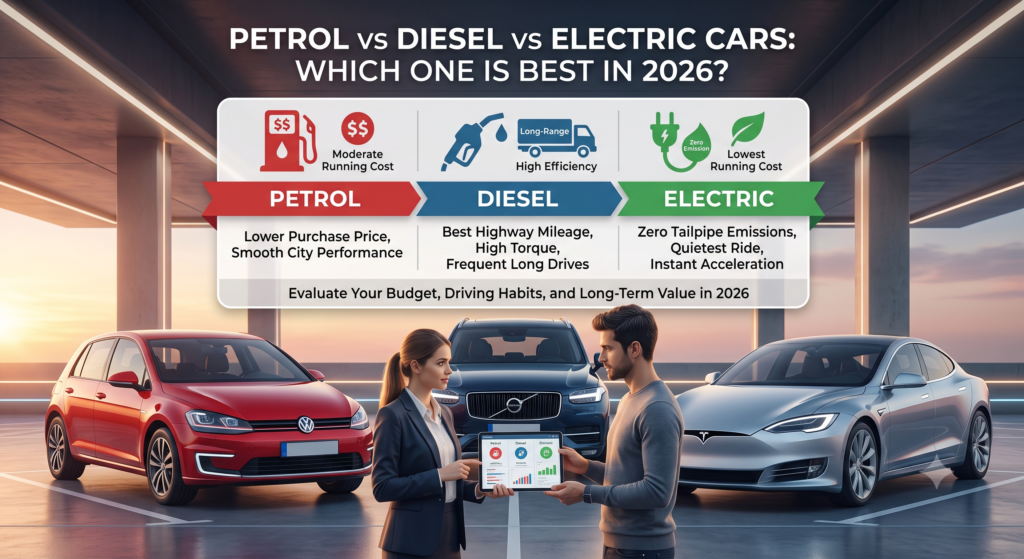
Petrol vs Diesel vs Electric Cars: Which One Is Best in 2026?
Choosing a new vehicle is one of the most important financial decisions for many people. One of the biggest questions buyers ask today is Petrol vs Diesel vs Electric Cars—which option offers the best value, performance, and long-term benefits? As technology continues to evolve and fuel prices fluctuate, understanding the differences between these three vehicle types has become more important than ever.
When comparing Petrol vs Diesel vs Electric Cars, there is no single answer that fits everyone. The best choice depends on your driving habits, annual mileage, budget, maintenance expectations, and environmental concerns. Each type of vehicle has its own strengths and limitations.
In this complete guide, we’ll compare Petrol vs Diesel vs Electric Cars across several important factors, including purchase price, fuel economy, maintenance, driving experience, environmental impact, resale value, and long-term ownership costs.
Understanding the Three Types of Cars
Before comparing them, it’s important to understand how each type of vehicle works.
Petrol Cars
Petrol vehicles use spark-ignition engines powered by gasoline. They have been the most popular choice for personal transportation for decades due to their smooth performance and lower purchase price.
Petrol cars are generally ideal for:
- City driving
- Short daily commutes
- Occasional highway trips
- First-time car buyers
Diesel Cars
Diesel vehicles use compression ignition engines that provide higher torque and better fuel efficiency than petrol engines.
Diesel cars are commonly preferred by:
- Highway drivers
- Commercial users
- Long-distance travelers
- People with high annual mileage
Electric Cars
Electric vehicles (EVs) run entirely on battery-powered electric motors instead of internal combustion engines.
Electric cars are becoming increasingly popular because of:
- Zero tailpipe emissions
- Lower running costs
- Quiet driving
- Advanced technology
- Reduced maintenance
Purchase Price Comparison Petrol vs Diesel vs Electric Cars
The purchase price is often the first factor buyers consider.
Petrol Cars Petrol vs Diesel vs Electric Cars
Petrol vehicles generally have the lowest initial purchase price, making them attractive for budget-conscious buyers.
Diesel Cars Petrol vs Diesel
Diesel variants usually cost more than equivalent petrol models due to their more complex engines.
Electric Cars Petrol vs Diesel vs Electric Cars
Electric vehicles often have the highest upfront cost because battery technology remains expensive. However, government incentives and lower operating costs can offset the initial investment over time.
Winner: Petrol Cars Petrol vs
If your primary concern is affordability at the time of purchase, petrol cars usually offer the lowest entry price.
Fuel and Running Costs Petrol
One of the biggest differences in the Petrol vs Diesel vs Electric Cars comparison is the cost of operating the vehicle.
Petrol Cars Petrol vs
Petrol prices can fluctuate significantly, and petrol engines generally consume more fuel than diesel engines.
Diesel Cars Petrol vs
Diesel vehicles offer excellent fuel efficiency, especially during highway driving, making them economical for long-distance travel.
Electric Cars Petrol vs
Charging an electric vehicle typically costs much less than filling a fuel tank with petrol or diesel.
Owners who charge at home often enjoy substantial savings over several years.
Winner: Electric
Electric vehicles usually have the lowest daily running costs.
Maintenance Costs Petrol vs
Maintenance plays a major role in the overall cost of ownership.
Petrol Cars Petrol vs Diesel vs Electric Cars
Petrol engines require:
- Oil changes
- Spark plug replacement
- Air filter replacement
- Regular servicing
Maintenance costs are generally moderate.
Diesel Cars Petrol vs Diesel vs Electric Cars
Diesel engines require additional maintenance for components such as:
- Fuel injectors
- Turbochargers
- Diesel particulate filters
- Emission control systems
Repairs can become expensive as the vehicle ages.
Electric Cars Petrol vs Diesel vs Electric Cars
Electric vehicles have significantly fewer moving parts.
They do not require:
- Engine oil changes
- Spark plug replacement
- Exhaust repairs
- Clutch replacement
Routine maintenance mainly includes:
- Tires
- Brakes
- Suspension
- Battery health inspections
Winner: Electric Cars Petrol vs Diesel vs Electric Cars
Electric vehicles generally have the lowest maintenance requirements.
Performance Comparison Petrol vs Diesel vs Electric Cars
Performance is another important factor when comparing Petrol vs Diesel vs Electric Cars.
Petrol Cars Petrol vs Diesel vs Electric Cars
Petrol engines provide smooth acceleration and refined performance.
They are enjoyable for city driving and everyday commuting.
Diesel Cars Petrol vs Diesel vs Electric Cars
Diesel engines generate high torque, making them ideal for:
- Highway driving
- Heavy loads
- Long-distance travel
- Mountain roads
Electric Cars Petrol vs Diesel vs Electric Cars
Electric motors deliver instant torque.
Benefits include:
- Quick acceleration
- Smooth driving
- Silent operation
- Excellent responsiveness
Many electric
cars outperform conventional vehicles during acceleration.
Winner: Electric Cars Petrol vs Diesel vs Electric Cars
Electric vehicles provide the quickest and smoothest acceleration.
Driving Experience Petrol vs Diesel vs Electric Cars
Every vehicle type offers a unique driving experience.
Petrol Petrol vs Diesel vs Electric Cars
- Smooth
- Quiet
- Responsive
Diesel Petrol vs Diesel vs Electric Cars
- Powerful
- Excellent for cruising
- Slightly louder engine
Electric Petrol vs Diesel vs Electric Cars
- Extremely quiet
- Instant acceleration
- No gear changes
- Minimal vibration
Many first-time EV drivers are surprised by how refined electric vehicles feel.
Environmental Impact Petrol vs Diesel vs Electric Cars
Protecting the environment has become an important consideration for modern buyers.
Petrol Cars Petrol vs Diesel vs Electric Cars
Petrol vehicles produce carbon dioxide and other emissions during operation.
Diesel Cars Petrol vs Diesel vs Electric Cars
Diesel engines are fuel efficient but also produce nitrogen oxide emissions and particulate matter.
Electric Cars Petrol vs Diesel vs Electric Cars
Electric vehicles produce zero tailpipe emissions.
When charged using renewable electricity, their environmental impact becomes even lower.
Winner: Electric Cars Petrol vs Diesel vs Electric Cars
Electric vehicles are the most environmentally friendly option among the three.
Driving Range Petrol vs Diesel vs Electric Cars
Range remains an important factor for many buyers.
Petrol Cars Petrol vs Diesel vs Electric Cars
Refueling takes only a few minutes, making petrol vehicles suitable for long journeys.
Diesel Cars Petrol vs Diesel vs Electric Cars
Diesel vehicles often offer the longest driving range because of their excellent fuel efficiency.
Electric Cars Petrol vs Diesel vs Electric Cars
Modern EVs continue to improve in range, with many models capable of traveling several hundred kilometers on a single charge.
However, charging still requires more time than refueling with petrol or diesel.
Winner: Diesel Cars Petrol vs Diesel vs Electric Cars
Diesel vehicles continue to lead in long-distance driving range.
Charging and Refueling Petrol vs Diesel vs Electric Cars
Convenience matters during everyday ownership.
Petrol Petrol vs Diesel vs Electric Cars
Petrol stations are widely available.
Refueling usually takes less than five minutes.
Diesel Petrol vs Diesel vs Electric Cars
Diesel refueling is equally convenient and widely available.
Electric Petrol vs Diesel vs Electric Cars
Electric vehicle owners can charge:
- At home
- At workplaces
- At shopping centers
- At public charging stations
- Along highways
Although charging infrastructure is expanding rapidly, charging times are still longer than traditional refueling.
Resale Value Petrol vs Diesel vs Electric Cars
Resale value depends on:
- Brand reputation
- Vehicle condition
- Market demand
- Government regulations
Petrol vehicles generally maintain stable resale values.
Diesel resale values vary depending on local regulations.
Electric vehicle resale values continue improving as demand increases and battery technology advances.
Safety Features Petrol vs Diesel vs Electric Cars
Modern petrol, diesel, and electric vehicles all offer advanced safety systems.
Common features include:
- Multiple airbags
- ABS braking
- Electronic Stability Control
- Traction Control
- Lane Departure Warning
- Automatic Emergency Braking
- Adaptive Cruise Control
Safety depends more on the individual model than the type of fuel.
Which Vehicle Is Best for Different Drivers? Petrol vs Diesel vs Electric Cars
Best for City DrivingPetrol vs Diesel vs Electric Cars
Petrol and electric vehicles are excellent choices for urban environments.
Electric cars are especially attractive because they offer quiet operation and lower running costs.
Best for Petrol vs Diesel vs Electric Cars Highway Driving
Diesel vehicles remain a strong option for drivers covering long distances regularly due to their fuel efficiency and extended driving range.
Best for Families Petrol vs Diesel vs Electric Cars
Families should consider:
- Safety
- Interior space
- Running costs
- Reliability
Petrol SUVs and electric SUVs are increasingly popular family choices.
Best for Petrol vs Diesel vs Electric Cars Budget Buyers
Petrol vehicles usually provide the lowest purchase price and lower insurance costs.
Best for Petrol vs Diesel vs Electric Cars Technology Enthusiasts
Electric cars offer:
- Large touchscreens
- Software updates
- Smart connectivity
- Advanced driver assistance features
Advantages and Disadvantages
Petrol Cars
Advantages Petrol vs Diesel vs Electric Cars
- Lower purchase price
- Smooth engine
- Widely available fuel
- Lower maintenance than diesel
Disadvantages Petrol vs Diesel vs Electric Cars
- Higher fuel costs
- Lower mileage
- Higher emissions
Diesel Cars
Advantages Petrol vs Diesel vs Electric Cars
- Excellent mileage
- Strong highway performance
- High torque
Disadvantages Petrol vs Diesel vs Electric Cars
- Higher maintenance costs
- More expensive purchase price
- Stricter emission regulations
Electric Cars
Advantages Petrol vs Diesel vs Electric Cars
- Lowest running cost
- Very low maintenance
- Zero tailpipe emissions
- Instant acceleration
- Quiet operation
Disadvantages Petrol vs Diesel vs Electric Cars
- Higher purchase price
- Charging takes longer than refueling
- Public charging infrastructure may still be limited in some areas
Frequently Asked Questions
Which car is cheaper to maintain? Petrol vs Diesel vs Electric Cars
Electric cars generally require the least maintenance because they have fewer moving parts than petrol or diesel vehicles.
Which car is best for long-distance Petrol vs Diesel vs Electric Cars travel?
Diesel cars are often preferred for frequent long-distance driving due to their fuel efficiency and long driving range.
Are electric cars suitable for city Petrol vs Diesel vs Electric Cars driving?
Yes. Electric vehicles are excellent for city driving because they are quiet, efficient, and inexpensive to operate.
Which type of car has the lowest Petrol vs Diesel vs Electric Cars running cost?
Electric vehicles typically offer the lowest daily operating costs, especially when charged at home.
Should I buy a petrol, diesel, or electric car? Petrol vs Diesel vs Electric Cars
The answer depends on your budget, driving distance, charging access, and personal preferences. Evaluate your daily usage and long-term ownership costs before making a decision.
Conclusion Petrol vs Diesel vs Electric Cars
The debate over Petrol vs Diesel vs Electric Cars doesn’t have a universal winner because every driver has different priorities. Petrol cars remain a practical choice for buyers seeking an affordable purchase price and smooth everyday performance. Diesel vehicles continue to excel for long-distance travel and high-mileage users thanks to their excellent fuel efficiency and strong torque.
However, electric cars are rapidly becoming the future of personal transportation. Their lower running costs, reduced maintenance requirements, advanced technology, and zero tailpipe emissions make them an attractive option for many drivers. As charging infrastructure continues to expand and battery technology improves, electric vehicles are expected to become even more accessible and convenient.
Before making your final decision, consider your budget, daily driving habits, maintenance expectations, and local charging or fueling infrastructure. Choosing the right vehicle today will ensure a comfortable, cost-effective, and enjoyable driving experience for years to come.